Showing posts with label foodies in activism. Show all posts

Friday, May 1, 2015

Food for Thought: School Gardens

As I was refilling the watering pot, I watched the school’s chef walk up the steps to the raised beds, a large metal serving tray in one arm and a pair of cooking-grade scissors in the other. He walked towards the garden bed that had rows of leafy greens, bent over, and began to carefully cut the arugula for that night’s dinner. I turned off the faucet, walked back to the non-edible garden area, and smiled while I watered.


In the last school year, a gardening club (heh) sprouted up at CK’s school. I have been volunteering my Saturday mornings in helping monitor the kids since March, but essentially working alongside them and learning in the process. 


I had found solace there among the raised beds and weeding efforts. I had found validation during the stressful moments of job searching and cover letter writing. It also made me want to try gardening again when I went back to the States.

School gardens, I believe, need to be at every school, private and public, from primary to post-secondary age groups. It was such a phenomenal moment to watch the chef cut the arugula greens knowing the students would enjoy the freshest ingredients for dinner. 


Even at CK’s school, having wholesome and fresh ingredients in their meals are too far and few in between. We’ve made it a big deal to say, “For lunch, this dish was made from various things from the garden.” It brings the kids who are part of the club a lot of pride. More often than not the ingredients tend to be frozen or canned in the kitchen, which isn’t a problem really, but since the garden's creation, school lunches have become more vibrant lately.

I can remember my school lunches with stomach-churning clarity (I’m looking at you, Fairfax County Public Schools). It was crap, it really was. And we continue to feed crap to children in the United States, wondering why there is a growing epidemic of obesity and malnutrition. We continue to medicate children for their overactivity, and yet we keep them inside all day. School gardens, much like the one I’ve been volunteering at for the last couple of months, should be more common.


Imagine: kids from ages 4 to 17 (even at University level) learning about the world around them and where their food comes from; kids contributing to their school lunches, and being willing to try fruits and vegetables they once claimed they’d never eat; kids beautifying their school grounds, learning about leadership, compassion for others, and respect for all; kids relishing the taste of a freshly harvested carrot; kids learning about bees and chickens and worms; kids growing up strong and confident.

Gardening is a huge activity, from weeding to seeding to watering to manning the compost pile. It creates dialogue and pride along with very tangible results.   


School gardens wouldn’t be hard to create. Most of the money, in fact, could be collected through fundraisers and donations. Detentions and free periods could be spent on the various day-to-day gardening activities. Individual classes could be responsible of certain food types or chores, rotating as needed or desired. Schools that struggle with a lack of understanding could grow it along with the seeds, and create a sense of community in the meantime. And even if the amount of food isn't enough to feed a school with over 500 students and faculty, the gardens could feed local shelters. 


Saturday, January 24, 2015

Celebrating 100,000+ pageviews with Birthday Cake!

I have an optimistic view of humanity. I believe in our potential. I believe in our ability to create. Above all, I believe in making a difference. Every one of us is capable for greatness, although greatness can seem very mundane and normal. Greatness doesn’t have to always mean fame or glory. Greatness sometimes doesn’t mean recognition either. Sometimes it means being there, for yourself or for another person, at the right place in the right way.


I thought I’d be elated when Meals with Morri hit another stepping-stone to success: one hundred thousand pageviews. It took almost four years, but it happened. I was excited, sure, until I started comparing myself to other gluten free bloggers out there: the ones who are published; the ones who are sponsored; the ones who found voices for their passions; the ones who seemed to stick to their path, so sure of what they wanted and continuing to evolve; and above all, the ones who were widely liked and talked about. Oh yes, the green monster called Envy hit me hard.

I really didn’t have a focus for Meals with Morri, other than seeing what I could make without gluten, soy, or cane sugar. I briefly touched upon having an under-functioning thyroid, some of the new ways I’ve learned to love my body (rock climbing, Insanity, yoga), my travels, a couple of book reviews and one for a product, and I thought about bringing activism into my writing. But for many years I was terrified of causing more harm than good with publishing what I thought, extremely careful in general to have a baseline of niceness and impartiality. Just focus on the food, not the politics, essentially.

Funnily enough, and quite embarrassing, it hit me the hardest when I happened to randomly click on one particular blogger: she's eighteen, a lover of yoga and fitness, cooks gluten free, had her site for less than two years… and she had over 1000 Likes on Facebook. Suddenly, the 100K didn’t seem to compare at all. Never mind that I have had people from all over the world read my blog and perhaps try my recipes. Never mind my personal journey to happiness and evolution. Never mind the Masters Degree. Never mind my ability to create and learn in the kitchen. Never mind the food.


It was politics, pure and simple, a popularity game that I so desperately wanted to win, or at least be a part of. I felt icky for feeling this way, until I realized what was beneath it: I felt like Meals with Morri didn’t matter anymore. And beneath that, I learned that of course it matters because I enjoy it. It matters to me. I connect with and learn about people and places through food. What I was yearning for, truly, was a focus, a niche, a way to really share with others.

While in Malta, I loved the people I worked with and what I did in the office, but I really struggled with living in the culture itself. I struggled with connecting with the Maltese people, and more often than not I spent my time at home after work, on Skype or doing Insanity. I felt like I didn’t belong there, awkward and foreign, simply because I couldn’t figure out how the island worked so that I could be a part of the island’s story. Similarly, I felt disconnected (and still do a little) from Meals with Morri.
 
One of my personal goals for this year is to learn to obtain internal validation. Up until this point, I was at school. It seemed like a pretty cut and paste sort of deal: I knew exactly what I was doing, and who I was. Without school and the unknown looming ahead in 2015, I was terrified. I didn’t know who to ask how I could be successful, and I didn’t know what questions to ask. I nitpicked at my choices, about why I just couldn’t be successful, why I was doing it wrong or wasn’t doing enough to get where I wanted to go. Meals with Morri went under the microscope, and I tore it apart with my fears.


But then I remembered: I didn’t start Meals with Morri for the glory. I started it because I thought it would be a fun way to empower myself in the kitchen and teach others about what I know about my trials and successes. I didn’t know that I would also go down the route of utilizing conflict resolution for food security and agriculture issues, hoping to work with local projects to redesign the cities/towns/neighborhoods they call home in bringing effective, self-efficient change. I was worried that Meals with Morri wasn’t the place for that. I was worried that I would lose that connection with people if I started talking about things that were, to be frank, political. 


What’s the saying? You cannot have your cake and eat it (too), right? It may not work out, but that can be said about a lot of things. I have no idea what this year is going to be like, considering that, at some point, I will have a job (hopefully one that is relevant and the people have similar passions) that will help in making a positive something happen. But I do know that I love food, I love the process and the people behind food, and I love the idea of bridging people together to finally work together along with this big blue marble we call home.

So at this juncture I’m just going to wing it. I’m going to start putting myself out there more, reaching out and trying new ways of connecting with others outside of my circles, network more openly, and to start believing that I can do things without other people validating me or giving me permission. I’m going to have that cake, eat a slice, and share its recipe.

This cake recipe has been part of a number of birthday celebrations for as long as I can remember. It’s one of the first desserts I made by myself, and it’s an easy one to do. The recipe I modified is found on the Hershey’s website, and I have used both King Arthur’s Multi-Purpose GF Flour as well as my choice of flours to make it. I substituted the cane sugar for coconut sugar with great success, and have made the cake in various shapes and sizes without any issue. I have also been able to halve and quarter the recipe depending on the number of people who are going to eat it without any issue.

It is the cake that Mama Dazz always asks for her birthday, and one that non-gluten freers are always happy to share with me. Since it is rather sweet, at least for my taste buds, I usually serve it with a lightly sweetened whipped cream but it would also do well with ice cream, fruit preserves, or a homemade caramel sauce.

I’ve made this recipe as cupcakes, as a thin sheet cake, and as thick round layers on top of each other. It is an incredibly easy and satisfying thing to make for whatever occasion you can think of celebrating, even if it’s to celebrate a quiet weekend at home.  

  
Healthified Chocolate Cake (adapted from Hershey’s recipe)
360 g Coconut palm sugar
126 g. Cocoa powder
1 1/2 tsp. Baking soda
1 1/2 tsp. Cream of tartar (or apple cider vinegar)
2 Eggs
90 ml Olive oil
240 ml Boiling water
140 g Rice flour
70 g Almond flour
1 tsp. Sea salt
240 ml Whole milk
2 tsp. Vanilla extract

Preheat oven to 350°F.
Grease and flour two 9-inch round baking pans.*
Stir together the coconut sugar, flours, cocoa, leavening agents, and salt in a large bowl.
Add the eggs, milk, oil and vanilla, and then beat on medium speed of mixer 2 minutes (or by hand with wooden spoon.
Slowly, and in increments, stir in the boiling water (batter will be thin).
Pour batter into the prepared pans and bake for 30 to 35 minutes or until wooden pick inserted in center comes out clean.
Let the cakes cool for 10 minutes, and remove from pans to wire racks.
Allow them to cool completely before serving.

Makes 12 servings.

*Variations (directly from Hershey’s website):

For one-pan cake: Grease and flour 13x9x2-inch baking pan. Heat oven to 350° F. Pour batter into prepared pan. Bake 35 to 40 minutes. Cool completely. Frost.

For a three-layer cake: Grease and flour three 8-inch round baking pans. Heat oven to 350°F. Pour batter into prepared pans. Bake 30 to 35 minutes. Cool 10 minutes; remove from pans to wire racks. Cool completely. Frost.

For a Bundt cake: Grease and flour 12-cup fluted tube pan. Heat oven to 350°F. Pour batter into prepared pan. Bake 50 to 55 minutes. Cool 15 minutes; remove from pan to wire rack. Cool completely. Frost.

For cupcakes: Line muffin cups (2-1/2 inches in diameter) with paper bake cups. Heat oven to 350°F. Fill cups 2/3 full with batter. Bake 22 to 25 minutes. Cool completely. Frost. About 30 cupcakes.

Thursday, April 10, 2014

Bahrija Oasis: The Organic Label and The "Know-Your-Farmer" Local Movement Discussion

If you were to make the decision to go organic or support your local farmer, which would you choose? In many ways, while the organic movement has helped to create that conversation of how important it is to know where your food comes from and how it was grown/processed/made, the ‘label’ itself is worth noting.


“Permaculture is a holistic design philosophy and the art and science of creating community eco-systems in which plants, animals, human beings, and all forms of ecological diversity interact to produce a prolific, ecologically-sound, and regenerative system that can support itself and life indefinitely.”

On Tuesday I went to Bahrija Oasis, a permaculture center that has been practicing what it preaches for over a decade. My NGO brought along with us partners for a climate change and agriculture project currently in the works to better understand what an eco-friendly, local permaculture movement looked like in Malta. We spent half the day there learning about the following:

  • Permaculture and permaculture principles
  • Ecological gardening
  • Eco-restoration & biodiversity
  • Rainwater management
  • Forest gardening
  • Composting & compost toilets
  • Holistic approaches to land use
  • Ethical development

It was most certainly an inspiration, especially since my talk of gardens and homesteading causes CK to say, “I’m going to be living on a farm, aren’t I?” Everything that I have been reading about and aspiring to create a career around was what Bahrija Oasis embodied. The people responsible for the farms success combined traditional Maltese farming methods with the principles mentioned. I remember being in awe at how sustainable their practices were. They utilized old materials such as bathtubs, sinks, barrels, plastic bins, and tires. They used solar panels and a windmill for part of their energy use, and they even had a pond for aquaponics!


As we were walking, I asked our guide if he was organically certified, and remembered the look on his face was a struggle of being diplomatic yet critical of the label.

In truth, the organic label as I’ve come to see it in the United States is something that has so many loopholes you might as well be playing billiards; and it seems that parts of Europe is similar. While the definition of organic, in my opinion, should universally mean “(of food or farming methods) produced or involving production without the use of chemical fertilizers, pesticides, or other artificial chemicals”, it has come to mean something else. It has come to mean money for big business. Our guide mentioned that being certified organic seemed to only benefit big farms and industries, and even then the companies could get the certification with only a fraction of their product being organic.


Take Coca Cola for example. It has an organic label. So does Kellogg’s. And they say so in very small print of its origination under the organic logo. Suddenly, organic hasn’t come to mean the definition written above, but something that has become money-oriented and big business-friendly. The label has lost its meaning in the name of profit.

Source

The USDA has changed the playing field for organic certification. Farmers/Businesses who strive for the organic elite title can still use pesticides, fertilizers, and fairly nasty chemicals on their crop. Products can be called organic even when only a portion of the ingredients going to making the product is actually organic. And what’s worse is how much of a strain it is on local farmers. More often than not the signs at farmers markets will say: “Not certified organic, BUT free of pesticides and chemicals, pasture-raised, etc.” In other words, “We’re organic, but the certification process is bogus and we want to continue doing what we believe in.”

But that’s what the local movement is all about: knowing your farmer, knowing your food, and knowing the process. After reading No Impact Man, I learned that a good way to go about this movement was to create a relationship with the local movement, treating it like a blind date. Arrange a visit to the farms and take a tour. Learn their process and ask them about their practices. It’s a form of empowerment, making the decision to choose farmers based on what you believe in.


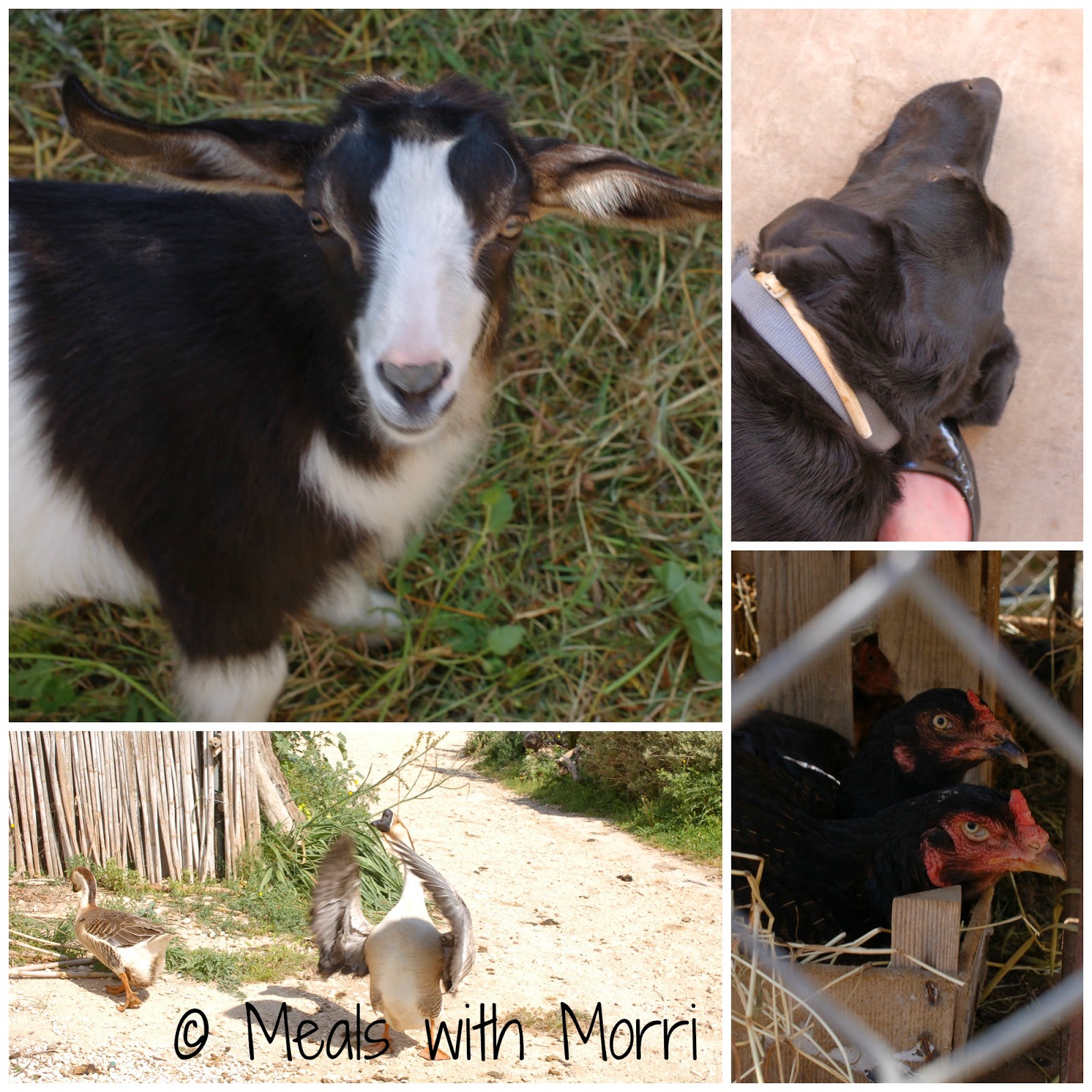
Bahrija Oasis may not be organically certified, but their methods are what I call organic. They apply the permaculture cycle with care, starting with the soil and ending with the soil. It is symbiotic, taking care of the earth and in turn being able to provide nourishment for yourself and others. While the farm itself is vegetarian, the use of animals is prominent: chickens and other fowl for eggs and bug control; goats for milk, weed management, and fertilizer; worms for nutrient-concentrated soil; and a dog for being a great companion and protector. Compost is a big deal here, as well as the usage of nettle tea as a fertilizer and natural pesticide.


So when our guide asked a fairly important question to us, “Which is more important, the organic label or supporting local movements?”, I knew where I stood. And the food (gluten free AND vegetarian) served at lunch was absolutely divine (much of it coming from the gardens). It was the first time I ever had wild thyme (also from the farm) tea, and I enjoyed it immensely.

Friday, April 15, 2011

Dialogue Over Dinner: Little Lamb Rounds

-->
The hardest thing about being a conflict resolution major is the relentless inspiration overload. I seem to experience this with every guest speaker I am introduced to. These are people who give my classmates and I a taste of what our futures could look like. They talk about their adventures, about their focus in the field, about their book(s), about their achievements and failures. There is a level of intimacy felt at every lecture, and in those moments after the talk is over, I picture myself doing what they do, making the world a better place, like a superhero of sorts.

But then, another guest speaker comes, and the previous lecture’s magical words are replaced by another person's.

And people wonder why it seems I’m so scatterbrained, like I don’t have any idea what I’m going to do with my life after graduation.

My answer? I’m going to live it. Conflict resolution isn’t a profession; it’s a discipline.

The reason I bring this up is because the guest speaker at yesterday’s conference inspired me. I mean, he really inspired me, in the “oh-my-goodness-he’s-doing-what-I-want-to-do” kind of way. His work literally combines the three things I identify with: conflict resolution, the arts, and food.

So just who was this amazing guest speaker that inspired me? The person whose talk ended with stars in my eyes and my heart swelling with emotion?

Tell me, have you ever heard of Busboys and Poets?

Anas “Andy” Shallal, an Iraqi-American artist, activist, and restaurateur, created B&P in 2005 as a community resource for other artists, activists, writers, thinkers, and dreamers. He was originally a biology major on his way to be becoming a doctor, but along the way he decided that it wasn’t his calling… so, he quit.

That stuck with me. There is an art to quitting at just the right moment. On the drive home after the lecture I considered the word “quit”. In reality, the word has a negative connotation to it that leaves such a bitter taste on the tongue. If someone calls you a quitter, it means you failed in the worst way possible, that you never see things through, that you are a disappointment to the human species as a whole. But Andy put it into perspective for me. I think he used the word “quit” to mean that, if something doesn’t resonate with you, you move on to things that do.

I mean, why stick with things you aren’t passionate about when there are other things out there that you could excel in simply because it’s an extension of what you’re all about?

The word “quit” shouldn’t always implicate laziness, fickleness, or giving up. To put it in a positive lighting, it means moving on and trying out other things until it’s the perfect fit. That’s not to say that I shouldn’t work towards the things I want, that I’m going to walk out on something when times are tough and I am face to face with failure now and then, or that I’m only going to do things I feel I’m really good at.

That’s not quitting. That’s being mediocre.

So I make it a daily practice to ask myself: Is this really working? If not, I move on.

That’s one of my mantras. “No” is just another word for “next”.

Anyway, Busboys and Poets is a community-gathering place, a public space where people are expected to come in with open hearts and not necessarily to change another person’s mind. The idea behind it is to “create an environment where shared conversations over food and drink allow the progressive, artistic and literary communities to dialogue, educate and interact.”

And it’s true what he said. There is something about food that brings out dialogue in any given place. Could it be one basic human need is being met and, therefore, we are more inclined to speak because something has been fulfilled? Could it be that the sharing of a plate between two people brings about a level of intimacy that wouldn’t otherwise be felt? Andy Shallal seems to have this down to a science. To paraphrase him: “Offer them food and they will come.”

Fired up? Got something to say? Here, have some hummus. Because, really, how can you say something hateful when there’s delicious food on the plate in front of you? How can you not try to understand an opposing view when it’s being discussed over piping hot coffee the way you like it and the tastiest sweets you have ever had?

B&P is a way to build a physical community within an era of social networking and cyber reality. Are your Facebook friends considered to be members of your personal community? Do you really define them as friends in real life? He was told that places like B&P, movie theaters, and other community gatherings would be obsolete in a matter of years, simply because people could socialize in the comforts of their own homes in front of their computer screens. The truth? Movie theaters and establishments like B&P are more prosperous than ever because people feel more alone, isolated, overwhelmed, and depressed than previous generations.

There is an upside, however. Without social networking I would have never been able to see what other gluten free bloggers are producing from their selective kitchens. I wouldn’t have many of the contacts that I have today. People from all over the world are part of the Food Revolution, and by using cyber space we can unite for the cause, share recipes, and tell our stories. Yet I think it is really just many communities linked by one belief system. Only when we come together and meet face to face does the community expand and flourish.

One day in the near future I hope to meet the bloggers who’ve inspired me to take my holistic journey to the next level, either at a conference or in a kitchen.

As for the B&P community, I had the chance to meet with Andy after his talk and gave him my contact information as well as the link to Meals with Morri. He is unquestionably a person that I want to work with. He is a man with such an open heart, kind eyes, and his work in the community is the perfect example of what I envision on doing after I graduate.

I originally intended on having a conflict resolution firm that focused on the community, but apropos to international issues (or vice versa). As my graduation date is less than twelve credits away from being a reality, it seemed that I had a knack in the kitchen, sharing good meals and amazing dialogue with people I love. Like Rémy (from my all-time favorite Pixar movie Ratatouille), “I can't choose between two halves of myself.” And quite frankly, I don’t want to.

I half-jokingly say to people, “all the time, the effort, the funding towards my college education… and half of me just wants to open a restaurant.”

Well, why not do both? Who’s to say I can’t?

The best conversations I’ve ever had were over food. Sometimes they were a little heated or hard things to discuss, but it seems that there was always a mutual understanding and genuine respect for one another, always a joint effort towards deep listening that was well maintained after the plates were licked clean. And when someone I love has a particularly bad day, I make a meal and offer myself to be present to them in every sense of the word. Over a meal, everyone has the ability to unclog their ears, open their hearts, and practice the art of appreciative inquiry. This recipe produced a similar outcome.


Little Lamb Rounds

1 lb. Ground lamb
1 Egg
1 Small red onion
1/2 c. Chopped spinach
1/4 tsp. Sea salt
2 Garlic cloves
1 tbsp. Olive oil
Dash of nutmeg and cinnamon, to taste

Preheat the oven to 375°F.
In a medium-sized mixing bowl, add the ground lamb, egg, salt, and spices.
Finely chop the red onion, garlic, and spinach (or put it through the food processor to make the veggies a consistent size), and put it into the bowl with the other ingredients.
Mix until thoroughly combined.
Make into balls roughly the size of your palm and put them into greased muffin tins.
Put it into the oven for 15 – 20 minutes or until done.

Makes 8 rounds. 

Serve with sour cream or tzaztiki as a sauce. I heartily recommend having it with a sweet potato and a light salad on the side to complete the dish.