Showing posts with label conflict resolution. Show all posts

Monday, July 14, 2014

Graduated.

Almost two months since a post. A first on the Meals with Morri site.

I’ve completed the Conflict Analysis and Resolution MS Program. My last class technically finishes on Wednesday, but I turned in my assignment early so I would have the weekend devoted to catching up on sleep and spending time with CK. This will be our longest time spent together, and my first summer spent with a partner ever, so you can imagine my excitement.

A lot has happened in two months. I took six credits worth of highly intensive schoolwork (as in, two graduate-level classes in the half the time) alongside working part-time and full time at my internship. I wasn’t sleeping well. I stopped exercising. I was a nervous wreck. I struggled.

But I did it. I’m done. Now, halfway through my internship, I feel like I can enjoy Malta for the rest of my stay.


I’m a bit behind in recipes, and I’m still processing the post-Graduate inevitability (sound familiar?), so please bear with me. My goal is to resume regular posting in August. For now, I'll be editing the website and brainstorming ideas on how to refine the Meals with Morri focus as well as what in the gods' names I'll be doing as a career.

In the meantime, thank you for visiting my area of cyberspace, and feel free to email me suggestions on what recipes you'd like to see in the upcoming months.

Risotto is an Italian classic, and one of my favorite rice dishes out there. CK and I have made it over Skype and together, and it’s one of those dishes that is easy to make and easy create variations with little to no effort at all. Pea and mint is a fantastic combination, and recipes for this risotto variation can be found everywhere.

Sweet Pea and Mint Risotto

25 g salted butter (or olive oil for a dairy free and vegan risotto)
1 Red onion, finely diced
400 g Arborio rice
1 glass of white wine*
200 g Fozen peas
1 tsp. dried mint
1 L water, hot (preferably boiling)**
Sea salt and cracked peppercorns, to taste

Parmesan cheese, to top***

Finely chop the onion and “sweat” (known as soffrito in Italy) it very gently in the butter over medium heat in a large saute pan or pot.
Add the rice and cook until it has a transparent look (this shouldn't take long) followed by the mint, wine, and peas.
When the wine is more or less gone, add the water (or stock) a little bit at a time (never submerged).
Keep stirring it and keep adding more liquid as it cooks away, about 15 to 20 minutes.
Taste to see if the rice is done: the rice should be soft, but have enough bite to it to feel the individual grains of rice.
Serve immediately with Parmesan cheese*** on top.

Makes 4 – 8 servings.

*A traditional risotto usually calls for a dry to semi-dry. I had a bottle of Maltese white wine that was sweet but with a dry aftertaste. It gave the risotto a wonderful depth of flavor that harmonized well with the sweetness of the peas and the coolness of the mint.
** One easy way to maintain the heat is using an electric kettle.
*** For a dairy-free/vegan cheese replacement, I recommend nutritional yeast.

Tuesday, March 25, 2014

Combining Passions and Kissing Self-Censorship Goodbye

In two weeks I will be celebrating Meals with Morri’s 3rd Anniversary. Three years of recipes, change, and growth under the “delicious, nutritious, and gluten free” banner.

But that’s the thing: it isn’t simply about being a gluten free blogger anymore.


With the start of grad school and deciding to live in Malta to gain experience in the sustainable development field, I’ve noticed, with disdain I might add, how little blogging I’ve actually been doing since, well, life happened. And it’s not that I don’t cook. I do. And it’s not that I don’t have anything to say. I do, and do so quite loudly. But so much change as left me overwhelmed and depressed at times, and the last thing I want to do is resent my passions by feeling obligated.

As the three-year mark looms closer, I realized I’d been censoring myself on this site. Why? Because gods forbid I make someone uncomfortable with what I write. Gods forbid someone among the thousands of readers who read and test my recipes get so upset that they stop reading Meals with Morri forever. All my life, everyone’s opinions of me mattered and I would harshly internalize when I did or said something ‘wrong’.

I promise you, this rant has a point.

I’ve kept my activism and Meals with Morri aspect separate, when in reality it was through blogging during my studies in conflict resolution that kick-started my passions and what I wanted to do with my career. Through blogging, I learned about sustainable development, climate change, responsible agricultural practices, holistic health, public policy, food politics, yoga, rock climbing, positive body image, and more. Suddenly, the idea of bringing food into my conflict resolution practice didn’t seem so ridiculous.

Which brings me back to my self-censorship. At one point early on in my blogging career, I actually went back and softened up certain words or phrases that seemed ‘critical’ (I stopped using the word ‘hate’ at some point). I wasn’t spouting hatred and “I’m right, you’re wrong” nonsense; I was simply offering my critical opinion of where I stood.

So with the three-year mark coming up, I began to ask what I had to show for it. I have almost reached 100,000 pageviews and seen all over the world with 231 blog posts, and am planning new pages that emphasize my passions. I have a series of ideas in how to broaden my horizons (within and outside the MWM boundaries), which includes: foodie videos, getting published on other sites, reflections on activism, and interviews with compassionate individuals in various fields.

Qarabaghli mimli fil-forn (Maltese translation: Stuffed Courgettes; inspired recipe here
4 Large marrows (roughly 1 Kg or 2 lbs.)
1 Large red onion
1 Garlic clove
2 Dried Bay leaves
2 Large tomatoes
2 tbsp. Tomato paste
300 g Ricotta*
2 Large eggs**
4 tbsp. Grated Parmesan cheese or Kefalotyri***
Olive oil
Fine grain white corn polenta
Sea salt
Cracked pepper

Preheat the oven to 180°C/350°F, and lightly coat the baking dish with olive oil.
Cut the marrows lengthwise in half and scoop out the insides with a teaspoon.****
On either side of the marrow, coat with the olive oil that was used in lining the dish pan.
Fry the onion, garlic, bay leaves, and tomatoes in some olive oil until soft, followed by the tomato paste to cook for a further few minutes. (Be sure to remove the bay leaves!)
Add in the ricotta and mix thoroughly, allowing it to cool slightly before adding the eggs.
Season to taste preference (although the cheese was salty enough for me).
Fill the marrow halves with the cheese-veggie mixture and then lightly sprinkle with the polenta (roughly 1/4 tsp. per marrow) followed by the grated cheese.
Bake for about 45 minutes until the marrows have softened and the mixture has firmed and slightly browned on top.
Serve hot (although delicious cold) on top of potatoes, rice, beans, or whatever you’re craving.

Makes 8 stuffed marrows. Servings vary depend on meal type.

Vegan Options include: *300 g drained and mashed (although not smooth) cooked black beans; ** 2 Flax eggs; *** 4 tbsp. Nutritional yeast

**** The recipe called for using the pulp, but I found that I really didn’t have the space for it in the recipe. Since this recipe is apparently great with baked MDP’s, I suggest finely chopping the pulp and sauteing it with potatoes along with onion and garlic. Also, to keep the halves upright, I sliced a small sliver from the outside.

Friday, September 27, 2013

Growing a Green Thumb

If there is one thing I’ve learned this year that has forever changed my outlook of things, it is this: Green Thumbs are planted.


Up until Meals with Morri transformed my perception of health and food, I never really sought to answer the question, “Where does our food come from?” We go to the supermarkets and farmers markets, many of us not realizing the time and effort it takes for such things to get onto our plates. Sure, perhaps I had this inkling when I visited Hollin Farms and saw the pumpkins on the vines and the various root vegetables in the ground. But there was this disconnect of understanding the concept of gardening for me, believing farmers (both in the rural and urban sense) and people who could grow herbs on their porch to have this niche I just didn’t inherit. Most of my caring for flora had turned dry and brown and… well, dead. So at an early age, I thought I was a serial killer for all of green-kind.

That changed in college. I kept a couple of plants sporadically throughout my undergraduate studies, mostly the seasonal potted plants from Trader Joe’s. I was able to keep a clover plant alivelonger than I had expected, and it then transitioned to a series of succulents, a spider plant, and then a lavender plant. Except for the clover plant, the first of my Green Thumb experiments, the rest are alive and well based on this crucial secret: the amount of sun, water, and soil type a happy plant makes.


 The year 2012 was a crucial point in my Green Thumb Development. Although I was adamant about having a garden, I didn’t feel confident enough to try; instead, I began reading all I could about the where’s, how’s, why’s, and when’s of food production and gardening. “Sustainable development” was the term I fell in love with and desire to understand all I could to combine certain aspects of food and the conflict resolution discipline. I studied urban farming, vertical gardening, the controversy of GMO politics, food security, hunger, and the “local movement”.

By 2013, Grad School was in full swing and Meals with Morri was put on the back burner in the worst way. For someone to go at it full-time, sacrifices are made on how many hours you work, how often you see friends and family, when you can travel and for how long, and downtime. (And blogging? Forgetaboutit.) I was an emotional wreck during the spring semester, and I was so burnt out by the summer that I didn’t have the energy to do anything. Frustration and anger simmered beneath the surface, with the feeling of hopelessness and total lack of control constantly looking me in the mirror. I began doubting everything, especially my ability and readiness for what awaits me after graduation: Do I have the knowledge to be part of a collaborative process in food security and policy? Will I have a career that I believe in?

At the end of May, what with finals finishing and summer school starting, I took up gardening and the Insanity Workout challenge to deal with the depression that began to form. I meant to talk about both months ago (including said depression), but the more I fell in love with both concepts and the more the situational depression darkened my disposition, the more quiet I became about it. In truth, I was afraid that if I wrote about the processes and failed en route, there would be a documented reminder of those failures for the entire world to see, and thus creating one more reason to be upset. My friends and family knew about both exploits, but I wanted to post the finished products (in other words, the triumphs) on the site.


But I saw both experiments through, and I am extremely proud of myself for that. I finished Insanity after ten weeks (still doing it from time to time, although not as religiously as the 6x weekly schedule), and I started that garden I always wanted. “There are worse things to do during Grad School,” Mama Dazz had said a joke, because when I am set to do something, I do it (and this can be positive and negative, depending on the context).
 
That being said, it all started with dirt.

Correction: It all started with one thousand pounds of dirt.


Mama Dazz gifted me with ten tree planter containers, in the logic that container gardening was easier to manage and you could control the type of soil you worked with. I initially started with small plants ready for transfer (nothing fancy… just Home Depot purchases): two tomato plants, three pepper plants, two garlic cloves (from the store), one cucumber plant, one okra plant, seven sweet potato plants, and a series of herbs that I thought would be good for beginners. I also transplanted my elderberry bush into one, and after it finally assimilated to the outdoors, it began to thrive beautifully.

I used two cinderblocks to plant flowers from packets I bought from MOM’s Organic Market, and a plastic container to grow bell peppers from seeds we got at Trader Joe’s. I also simply planted a whole pumpkin into the ground last fall to see if it would be as successful as the accidental garden I had the year before…  you know, just for giggles.


To reiterate, I didn’t do this to eat what I grew, but to go through the process of tending to different kinds of plants and learning what helps them grow or causes them to fail. Both the cucumber and pumpkin plants didn’t turn out so well. I got one cucumber from the plant early in the summer, but after that the little cucumbers that could were consistently shriveling up. The pumpkin created beautiful leafs and flowers until the white spots formed and the flowers were falling off. The vine showed signs of rot, and thus I gave it (along with my cucumber plant) a proper burial in my compost pile.


The nightshades were the most successful and the easiest to grow. So successful, in fact, that both tomato plants are heavy with fruit and the peppers popular among the pests. 


The sweet potatoes were my instant gratification harvest; even though the tubers were relatively small, I still enjoyed pulling them up from the soil and seeing what ninety days in the soil did for their growth.


Gardening gives me a sense of responsibility and control while dealing with stress. It’s a meditation of sorts to go outside in the morning and/or in the late afternoon, turn on the hose and do my rounds (starting with the quince tree I got Mama Dazz, refilling the birdbath, and then watering my garden). I feel empowered that I can work with plants and learn how they succeed and how they perish.

I feel my Green Thumb rooting itself in my consciousness for the future, and that future is currently looking into beets, winter greens, carrots, and radishes for a December harvest.

Thursday, April 25, 2013

Down-to-Earth Vegetarian Gumbo

Quite a few people were surprised at my lack of celebrating Earth Day. To them, I’m this all-loving, tree-hugging hippy chick that has a gluten free blog. And while I do happen to love quite a lot of things (and yes - I have, on occasion, hugged a tree), I treated Earth Day like any other day. I went to work, rested from Sunday’s epic climb, and slept. Graduate school has me napping like a champ these days.

To be fair, I had planned on posting something in the name of Earth Day: a recipe symbolizing the coming together as a global community to work on the environmental issues we have today. But for some reason I have too tired to focus on anything but school and work this semester to do anything else. It was marked on my calendar and everything.

(source)

I remember early in the semester watching The 11th Hour in my Environmental Conflict Resolution class. We didn’t get to finish the film, so I left the room absolutely horrified by what the world has dealt with. True, the movie is meant to stress the consequences of pollution, overfishing, and taking more resources than we give back, but it definitely hit home for me. For the first time, this hippy was very angry at humanity… and feeling very insignificant in how she could make things better. How in the world could my attempts in using energy-efficient light bulbs or turning off the thermostat once in a while solve anything? That's the point, though, isn't it. We can't do it alone.

The reason why food has become my focus in conflict resolution has much to do with environmental awareness. I’ve become fascinated by the sustainable and “know your farmer” movement, which is why I’ve decided to devote a post every week to a farmers market outing starting in May. Each week will be a different market highlighting the amazing farmers that make them unique and delicious.

It may not save the world of all its problems, but it’s a start.

Vegetarian Gumbo

21 g Unsalted butter (or olive oil for a herbivore friendly dish)
21 g Olive oil
30 g Garbanzo bean flour
1 qt. Veggie broth or water
1 Carrot, finely diced
1 Celery stalk, finely diced
2 Yellow onions, finely diced
3 Shallots, finely diced
2 Garlic cloves, coarsely chopped
454 g Chopped bell peppers (I used a combination of green, yellow, and red)
794 g Canned whole and peeled plum tomatoes, drained and coarsely chopped
3 tbsp. / 7 g Dried parsley
1 tsp. Dried thyme
1 Bay leaf
1 tbsp. Coconut aminos (or gluten free Worchester sauce)
1 tsp. Sea salt
1 tsp. Ground pepper
283 g fresh/frozen okra (cut into 1/4-inch slices)

In a large pot on medium-low heat, melt the butter with the olive oil until it begins to bubble.
Slowly stir in the garbanzo bean flour and once thoroughly combined and slightly browned (there should be a distinct nutty smell), followed by carefully pouring in the vegetable broth in manageable increments.
Add in the vegetables and spices to cook on medium heat for forty minutes to an hour.
Turn off the heat and remove the bay leaf.
Ladle into bowls over rice while hot.

Makes 6 – 8 servings.

Monday, December 3, 2012

Have Yourself a Merry Little December

I’m one of those people who start the holidays right when I wake up to the December 1st morning. Pandora is devoted to secular holiday music with songs sung by The Rat Pack, Ella Fitzgerald, Louis Armstrong, Bing Crosby, and many others. The Christmas lights are shining brightly around our doorway, inviting good cheer to everyone who enters our home. This week is devoted to getting into the Yuletide spirit, putting the tree up and decorating, preparing for finals, and cooking up a plethora of winter based recipes.

In the last month of the year 2012, I have been looking at past blog posts and life decisions fervently, awed by how much has changed and inspired by how far I’ve come. I’ve found my passions in food have surpassed my expectations and evolved into something leaning towards sustainable development, urban agriculture, the local and organic movements, gardening, and “know your farmer”. My fitness regimen in the form of rock climbing and yoga, although sometimes appearing lack in progress at times, has conditioned my body (and spirit) in ways I couldn’t have imagined when I first started.

And in December of last year, I couldn’t imagine being a successful graduate student, let alone being accepted to the graduate school program. My acceptance letter came last week, and already plans for the spring semester are being laid out to balance all the loves in my life. I’m currently working on time management week by week, only because the semester is almost over. But goodness, I’m an official S/CAR graduate student… Me. Accepted.

Holy cow.

So while I hum to Ella Fitzgerald’s version of “Have Yourself A Merry Little Christmas”, I figured to honor my acceptance by making socca, a food I’d fallen in love with over a year ago but haven’t made another recipe since my "Happy Herbivore Tendencies" post. That’s way too long a break in between without socca, I say, and started thinking of a recipe to share. I wanted to use up the remaining pumpkin puree in the fridge, but I was also hankering for an old school peanut butter and banana sandwich.

Let’s just say my craving was more than satisfied, and that pumpkin works beautifully with peanut butter and banana.

Pumpkin Socca

120 g Garbanzo bean flour
180 ml Filtered water
5 ml Whey (optional)*
240 g Pumpkin puree
1/2 tsp. Sea salt
30 g Butter (for a dairy free and vegan version, you could use coconut/olive oil)

In a small mixing bowl, stir the flour, water, and whey until thoroughly combined and let it sit overnight on the counter.
Add the pumpkin and sea salt while melting the butter on medium heat in a cast iron skillet; once beginning to brown, drizzle the excess fat into the batter.
Pour the batter into the skillet and treat it like you would a pancake, either flipping over or using the broiler to cook the other side.
Turn off the heat and transfer it onto a plate to cool slightly (the inside is delicious custard when hot and solidifies as it cools). 
Cut into quarters, bars, or squares to enjoy as you like and serve warm.

Makes 2 servings.

Socca is a great bread substitute to make sandwiches. For two peanut butter and banana soccawiches, slice the socca in half, smear 2 tbsp. peanut butter (or any nut butter of your choice) and slice one ripe banana thinly on one side of the socca. Fold the other side on top and cut the socca again so you have two – four sandwiches on a plate. Enjoy with a glass of milk (dairy free or otherwise). 

Sunday, October 16, 2011

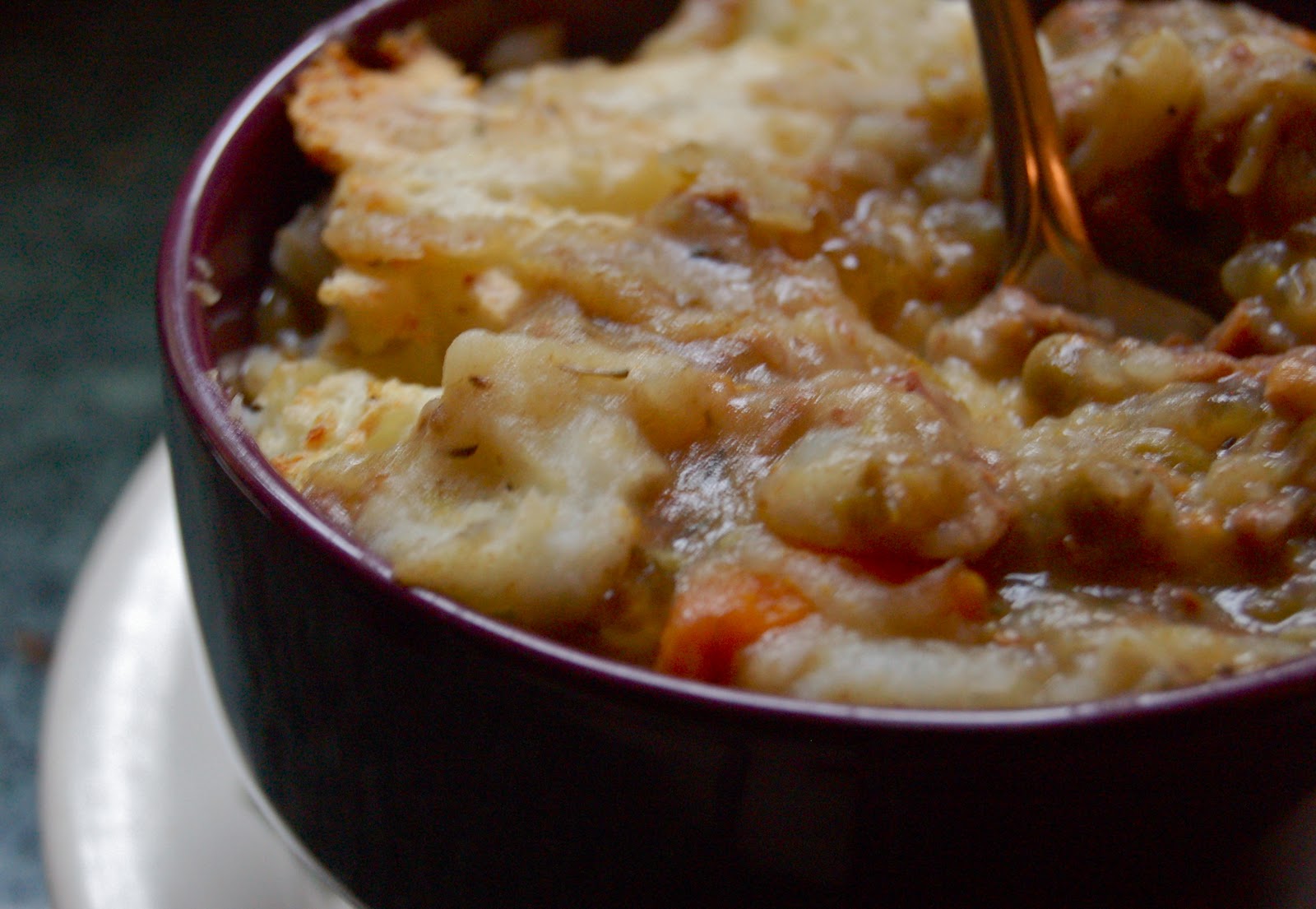
Cottage Pie

Do you ever have those moments where you ended up questioning something, even things in the past you didn’t have control over in the first place? Do you ever think you took the wrong path, whether it is for a career or a college major? My blogging activity waned for five excruciatingly long days, just as my motivation had for school. I kept cooking, and I kept going to school, but when it came time to study the weekly readings or blog my latest recipe, I couldn’t focus, my eyes glazed over, my mind went blank, and all I wanted to do was sleep and hide from the world.


Yesterday all I did was sleep, and I was still exhausted. My inability to sleep more than six hours without the compulsion to get up each night was starting to get to me (zombie-free, thank goodness). I look out from my bedroom window, gazing at the beauty of this clear autumn day, and I can’t help but feel so disconnected from the Cosmos. I don’t feel like I’m part of my own life.

So I’m looking back at my college career, and I think about Steve Jobs and Chris Botti. Both men are geniuses of their respective crafts, Jobs with computers and Botti with his trumpet. Neither one of them completed college (Jobs dropped out and then back “in” college, only taking the classes he found interesting and Botti dropped out to pursue the life of a musician), but look at the impact they’ve made in the world! I started thinking to myself, my minor classes in anthropology were the ones that kept my GPA under a 3.5, and suppose if I decided use those credits to take the classes I found interesting. Where would my GPA be? Where would I be as a person if I took a year off before going to school and traveled? A lot of recent opportunities have come up in the S/CAR program, opportunities that I can’t be part of because this is my last semester as an undergraduate. Maybe this is where it all started, when I found out that future S/CAR majors would have the ability to turn their senior year into their first year of the Masters program. That, and the fact that I still haven’t heard anything about my grades from Sweden transferring, that kept me from filling out my application and, in my mind, hindering my ability to being selected for the upcoming spring.

For the past few weeks I’ve been angry and frustrated and sullen. I was angry because I felt cheated, because I didn’t know what George Mason could have offered me if I hadn’t taken on the anthropology minor. I was frustrated because all the motivation and drive I had was quickly fading, and December was looming closer and closer. And I was sullen, because the only thing that was keeping me from the people that mattered most to me and inhibiting me from doing the things I loved and wanted to do was, well, me.

The nervous breakdown last night, in front of my family and friends, was my turning point. We all get together on a monthly basis to eat, love, meet new people, and discuss new ideas and philosophies. We started talking about the concepts of Wyrd and Ørlög, or fate and its path, as it is known in the Old Anglo-Saxon and Germanic cultures, and despite all my efforts to not break down, the tears fell and I excused myself for the rest of the discussion. It was at that moment I knew I didn’t feel connected to something I felt I should have been, and that my fate and destiny were secrets I wasn’t in on that they might as well not exist. What was I going to do with my life after graduation? What credentials could I possibly have that gave me a doorway to do something great for the world? What was the point of going through higher education when upon graduation I don’t feel prepared for life outside of academia? I am scared, so completely and utterly terrified, and more than once I’ve half-jokingly told people I’m going to become a Buddhist nun just to get away from everything. I began doubting my ability as being a conflict resolution practitioner. I began doubting my ability to cook. I began doubting the things I loved and the things I was good at. I wanted to put the covers over my head and wait until graduation, to not eat or move or talk.

I sat there, petting my uncle’s two dogs while I calmed down, and a couple of people came down to check on me. I told them why I was a blubbering mess with tears in my hair and a heavy heart, spilling out my fears and my reflections. Two of them, brothers and roommates, said they went through the exact same thing before and after they left the military. In fact, most if not all who talked with me said they’re still trying to figure it all out. “Your career doesn’t define you”, my uncle’s girlfriend said, “but that doesn’t mean you won’t end up where you’re supposed to.” I left the get-together in better spirits than I had arrived. I couldn’t have felt more loved or supported, and for that I am grateful for the amazing family I have.

If it hadn’t been for following Mama Dazz’s incentive and looking into conflict resolution as a discipline, I wouldn’t be the person I am today. I learned the art of communication, the power of empathy, and have met the unsung heroes of this wonderful world we have. If it hadn’t been for George Mason or the S/CAR program, I wouldn’t have met the people whom I cherish more than anything, including my colleagues in my classes or the love of my life one fateful Halloween party two years ago. And finally, if I hadn’t been part of this program, I wouldn’t have gone to the conference last year and hear Andy Shallal’s speech that inspired me more than he will ever know.

Thinking about this, now, as I write this post, further reiterates what I’ve always known. Everything is connected. There is no such thing as a coincidence. I’ve been disconnected from the Universe because I’d lost my belief in the process. And when you turn your back on that process and distrust it, you become lost and your way is uncertain. You begin to fear the process, and what it might bring. 


When I was first looking into making shepherd’s pie for the family, put into my single serving Pyrex® dishes, I searched for other people’s recipes before I sought to create my own. Maybe I wanted a point of departure so I wouldn’t mess up something I’ve never made before. Or maybe I wanted to walk down a path already traveled. But then, I noticed none of the recipes were what I was going for. I was afraid to pave my own path, even if it was a recipe for cottage pie (and before you say it, there is a difference between the two recipes).

So, despite my revelation (and a bangin’ original recipe), am I still terrified, frustrated, and sullen? A little. Graduation is still coming up. Midterms are still this week. Morri is still a stressed out, hormonal mess. But you can’t change what has already happened, and you shouldn’t worry about the things you can’t control. Sometimes what other people have done before you isn’t exactly what you want to do. And there may be a better way to do what you have in mind.

Everything happens for a reason. Trust in the process. Believe in your fate and that path your fate is taking. So here, have some cottage pie for your journey. I guarantee you’ll feel better.

Cottage Pie

1.5 lbs Lean beef stew meat, chopped into bite-sized chunks
2 carrots (about 5.5 oz), peeled, quartered, and finely chopped
1 White onion (medium), peeled and finely chopped
5.25 oz Petite peas, fresh or frozen
3 tbsp. Olive oil
2 Garlic cloves, coarsely chopped
20 oz Water
1 tsp. Unrefined apple cider vinegar
1 Bay leaf
1 tsp. Thyme
1/4 tsp. Rosemary powder
1/4 tsp. Sage powder
1 tsp. Sea salt
1/2 tsp. Cracked pepper
3 (heaping) tbsp. Potato starch

4 Russet potatoes (about 2.5 lbs), cut into small chunks
2 Garlic cloves, whole
1 oz Salted butter
3 oz Sour cream
1/4 tsp. Sea salt
1/4 tsp. Cracked pepper

In a pressure cooker or large pot, combine the beef, veggies, water, and spices (sans the potato starch, and cook for at least an hour.
Preheat the oven to 350ºF.
Cover the potato chunks and garlic cloves with cold water in a medium saucepan and bring to a boil on medium-high heat until tender.
Drain the water and add the butter, sour cream, salt, and pepper, and mash the potatoes until there is a smooth consistency.
When the pressure has subsided in the pressure cooker, create a slurry with the potato starch (about 2 oz water) and add in with the meat and veggies on medium-low heat.
Once the stew thickens, turn off the heat, remove the bay leaf, and pour it into an oven-safe casserole pan.
Top it with the potato mixture and evenly spread it out.
Bake for thirty minutes or more if you want the potato to brown.

Serves 4 – 6 people.

Friday, April 15, 2011

Dialogue Over Dinner: Little Lamb Rounds

-->
The hardest thing about being a conflict resolution major is the relentless inspiration overload. I seem to experience this with every guest speaker I am introduced to. These are people who give my classmates and I a taste of what our futures could look like. They talk about their adventures, about their focus in the field, about their book(s), about their achievements and failures. There is a level of intimacy felt at every lecture, and in those moments after the talk is over, I picture myself doing what they do, making the world a better place, like a superhero of sorts.

But then, another guest speaker comes, and the previous lecture’s magical words are replaced by another person's.

And people wonder why it seems I’m so scatterbrained, like I don’t have any idea what I’m going to do with my life after graduation.

My answer? I’m going to live it. Conflict resolution isn’t a profession; it’s a discipline.

The reason I bring this up is because the guest speaker at yesterday’s conference inspired me. I mean, he really inspired me, in the “oh-my-goodness-he’s-doing-what-I-want-to-do” kind of way. His work literally combines the three things I identify with: conflict resolution, the arts, and food.

So just who was this amazing guest speaker that inspired me? The person whose talk ended with stars in my eyes and my heart swelling with emotion?

Tell me, have you ever heard of Busboys and Poets?

Anas “Andy” Shallal, an Iraqi-American artist, activist, and restaurateur, created B&P in 2005 as a community resource for other artists, activists, writers, thinkers, and dreamers. He was originally a biology major on his way to be becoming a doctor, but along the way he decided that it wasn’t his calling… so, he quit.

That stuck with me. There is an art to quitting at just the right moment. On the drive home after the lecture I considered the word “quit”. In reality, the word has a negative connotation to it that leaves such a bitter taste on the tongue. If someone calls you a quitter, it means you failed in the worst way possible, that you never see things through, that you are a disappointment to the human species as a whole. But Andy put it into perspective for me. I think he used the word “quit” to mean that, if something doesn’t resonate with you, you move on to things that do.

I mean, why stick with things you aren’t passionate about when there are other things out there that you could excel in simply because it’s an extension of what you’re all about?

The word “quit” shouldn’t always implicate laziness, fickleness, or giving up. To put it in a positive lighting, it means moving on and trying out other things until it’s the perfect fit. That’s not to say that I shouldn’t work towards the things I want, that I’m going to walk out on something when times are tough and I am face to face with failure now and then, or that I’m only going to do things I feel I’m really good at.

That’s not quitting. That’s being mediocre.

So I make it a daily practice to ask myself: Is this really working? If not, I move on.

That’s one of my mantras. “No” is just another word for “next”.

Anyway, Busboys and Poets is a community-gathering place, a public space where people are expected to come in with open hearts and not necessarily to change another person’s mind. The idea behind it is to “create an environment where shared conversations over food and drink allow the progressive, artistic and literary communities to dialogue, educate and interact.”

And it’s true what he said. There is something about food that brings out dialogue in any given place. Could it be one basic human need is being met and, therefore, we are more inclined to speak because something has been fulfilled? Could it be that the sharing of a plate between two people brings about a level of intimacy that wouldn’t otherwise be felt? Andy Shallal seems to have this down to a science. To paraphrase him: “Offer them food and they will come.”

Fired up? Got something to say? Here, have some hummus. Because, really, how can you say something hateful when there’s delicious food on the plate in front of you? How can you not try to understand an opposing view when it’s being discussed over piping hot coffee the way you like it and the tastiest sweets you have ever had?

B&P is a way to build a physical community within an era of social networking and cyber reality. Are your Facebook friends considered to be members of your personal community? Do you really define them as friends in real life? He was told that places like B&P, movie theaters, and other community gatherings would be obsolete in a matter of years, simply because people could socialize in the comforts of their own homes in front of their computer screens. The truth? Movie theaters and establishments like B&P are more prosperous than ever because people feel more alone, isolated, overwhelmed, and depressed than previous generations.

There is an upside, however. Without social networking I would have never been able to see what other gluten free bloggers are producing from their selective kitchens. I wouldn’t have many of the contacts that I have today. People from all over the world are part of the Food Revolution, and by using cyber space we can unite for the cause, share recipes, and tell our stories. Yet I think it is really just many communities linked by one belief system. Only when we come together and meet face to face does the community expand and flourish.

One day in the near future I hope to meet the bloggers who’ve inspired me to take my holistic journey to the next level, either at a conference or in a kitchen.

As for the B&P community, I had the chance to meet with Andy after his talk and gave him my contact information as well as the link to Meals with Morri. He is unquestionably a person that I want to work with. He is a man with such an open heart, kind eyes, and his work in the community is the perfect example of what I envision on doing after I graduate.

I originally intended on having a conflict resolution firm that focused on the community, but apropos to international issues (or vice versa). As my graduation date is less than twelve credits away from being a reality, it seemed that I had a knack in the kitchen, sharing good meals and amazing dialogue with people I love. Like Rémy (from my all-time favorite Pixar movie Ratatouille), “I can't choose between two halves of myself.” And quite frankly, I don’t want to.

I half-jokingly say to people, “all the time, the effort, the funding towards my college education… and half of me just wants to open a restaurant.”

Well, why not do both? Who’s to say I can’t?

The best conversations I’ve ever had were over food. Sometimes they were a little heated or hard things to discuss, but it seems that there was always a mutual understanding and genuine respect for one another, always a joint effort towards deep listening that was well maintained after the plates were licked clean. And when someone I love has a particularly bad day, I make a meal and offer myself to be present to them in every sense of the word. Over a meal, everyone has the ability to unclog their ears, open their hearts, and practice the art of appreciative inquiry. This recipe produced a similar outcome.


Little Lamb Rounds

1 lb. Ground lamb
1 Egg
1 Small red onion
1/2 c. Chopped spinach
1/4 tsp. Sea salt
2 Garlic cloves
1 tbsp. Olive oil
Dash of nutmeg and cinnamon, to taste

Preheat the oven to 375°F.
In a medium-sized mixing bowl, add the ground lamb, egg, salt, and spices.
Finely chop the red onion, garlic, and spinach (or put it through the food processor to make the veggies a consistent size), and put it into the bowl with the other ingredients.
Mix until thoroughly combined.
Make into balls roughly the size of your palm and put them into greased muffin tins.
Put it into the oven for 15 – 20 minutes or until done.

Makes 8 rounds. 

Serve with sour cream or tzaztiki as a sauce. I heartily recommend having it with a sweet potato and a light salad on the side to complete the dish.